
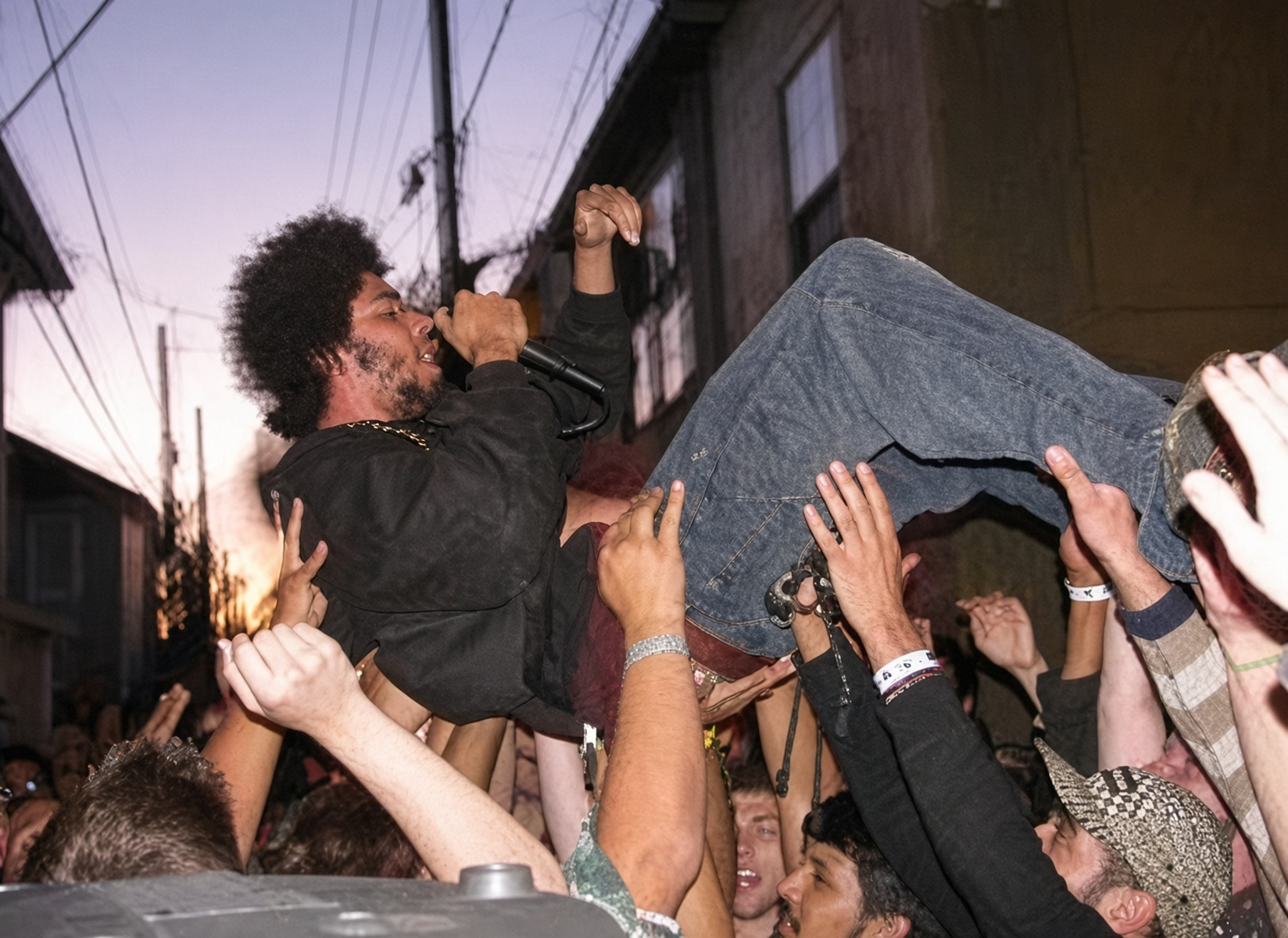
My son Khalil was born the day before the first Westheimer Block Party. This was October 2005, and I had managed to schedule the launch of a festival immediately after the arrival of a child, which tells you something about my qualifications as a planner. I was running back and forth to the hospital while trying to get stages built and vendors ready. Andrea did the actual work. I would like that distinction entered into the historical record before anybody starts congratulating me on a productive weekend.
We called the event West Fest Compressed. The first edition was on October 15, 2005, and the name was a fairly honest account of the situation. We wanted something of the old Westheimer Street Festival, but we had neither the footprint nor the permission to reproduce it. So we took a much larger idea and squeezed it into the places that would have us. It was an appropriate beginning for Free Press Houston: an independent newspaper, barely two years old, deciding that putting out a paper apparently left us with too much spare time.
The street festival before us
The Westheimer Street Festival belonged to an older Montrose. Its roots were entangled with the Westheimer Colony Art Festival, the neighborhood arts gathering of the early 1970s that eventually developed into Bayou City Art Festival. The juried art festival and the sprawling street celebration followed different paths, as the Chronicle's 2007 account of their common roots explains. Their shared geography should not be mistaken for one continuous organization, but they helped establish a durable Houston idea: people could turn a stretch of their own neighborhood into a public occasion.
Music, art, small businesses and the act of wandering around were all part of the attraction. There was something generous about being able to encounter a city without first buying a ticket to it. Montrose was particularly good at that. The festival gave the neighborhood permission to become more visibly itself, and people who might otherwise have remained inside separate clubs, shops and social circles ended up sharing the same pavement.
It also grew complicated. Residents had legitimate questions about crowds, sanitation, access and what happened after everybody went home. The city had increasing expectations of the people producing the event. By February 2000, the argument had reached the City Council minutes, which record the denial of the Westheimer Street Festival Corporation's appeal over its street-closure application. That was the earlier festival's fight, years before ours. We inherited the affection for the event and a street that was considerably harder to close.
A smaller map, a very large day
Our answer in 2005 was to work around Westheimer and Taft. Over the Block Party years, that meant Numbers, Mango's, La Strada and Helios—the latter now known as AvantGarden—along with neighboring spaces that could accommodate music and people. We concentrated the activity around a cluster of businesses rather than pretending we had the run of Westheimer itself. The venues were our practical infrastructure: existing rooms, sympathetic people, somewhere a band could plug in and an audience could gather.
The first printed map makes the geography wonderfully plain. Timothy J. Dorsey's drawing locates Numbers, Mango's and Helios around the Westheimer–Taft intersection, and sends people farther west to Imagine That on Montrose. The schedule on the facing page lists Helios downstairs and upstairs, Numbers, Imagine That and Mango's. La Strada became part of the later footprint. These distinctions matter because memory tends to fold several afternoons into one enormous afternoon, and the paper has the useful habit of interrupting us with a map.
Look at that first bill. At Numbers, the schedule ran from Southern Backtones through Satin Hooks, Hognose, Los Skarnales and Woozy Helmet, with DJ Sun at the end. Helios had Bo Jones, Mighty Orq, Studemont Project and Medicine Show. At Imagine That, The Dimes appeared alongside Organ Failure, Flowers to Hide, Rusted Shut and A Pink Cloud. Mango's listed Go Spread Your Wings, Free Radicals and Skyblue72. The 2005 edition record preserves the full advertised schedule rather than asking anybody's recollection to carry all thirty-six sets.
What I like about that page now is how little explanation it requires. This was Houston music, in a group of Houston rooms, being offered to the people who lived around them. The bands were not supporting evidence for a marketing concept. They were why we were doing it. We had a newspaper that could tell people where to go, musicians willing to play and venues willing to participate. Our confidence was well ahead of our experience, but for a while the two seemed close enough to proceed.
The education we gave ourselves
The Block Party was where we learned what producing an event actually meant. Publishing could get an idea in front of people. A concert required us to account for what those people would do when they arrived, how the next band would get onstage, where a vendor could operate and which part of the plan would fail if nobody was assigned to it. Each edition taught the staff something that the previous edition had allowed us to overlook.
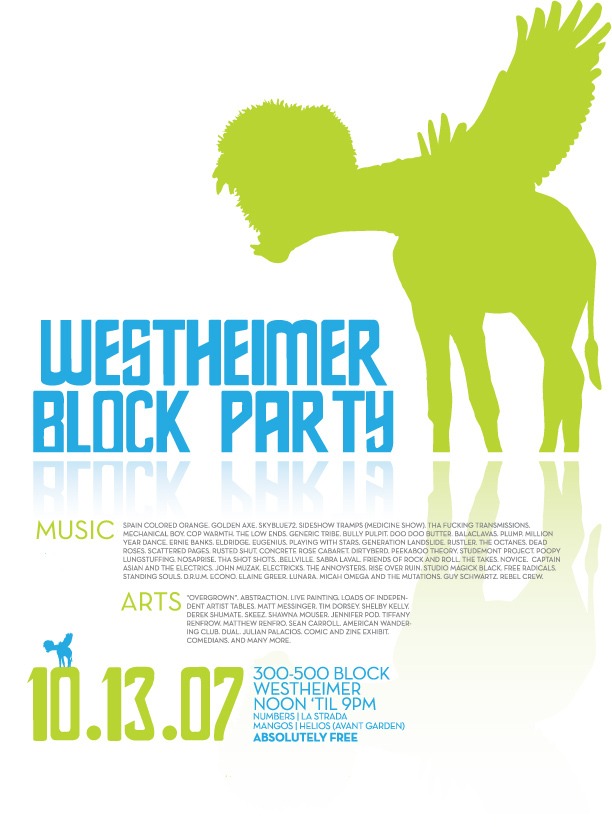
We learned booking by booking bands, promotion by trying to get people to leave their houses, and production by confronting the difference between a finished poster and a finished stage. The surviving posters and stage guides show the outward-facing part of that work. Behind each one were the less picturesque tasks that made the advertised afternoon possible. A newspaper deadline can be miserable, but the page does not usually need a sound check.
There was an innocence to the ambition. We believed the music being made around us deserved an audience, and that a publication ought to be able to help create one. People contributed labor, rooms, equipment, artwork, patience and the benefit of the doubt. We were learning in public, which is a beautiful arrangement when people are generous with you and a rather unforgiving one when the learning concerns crowd movement or an electrical connection.
The work also changed the paper. Writers, artists, musicians, venue people and readers were suddenly participating in the same event rather than encountering one another only through the publication. FPH became something you could walk into for an afternoon. That made the connection between the paper and the city feel immediate in a way circulation numbers never could. It gave us a reason to work harder, and occasionally a reason to confuse working harder with having solved the problem.
A conversation at Mango's
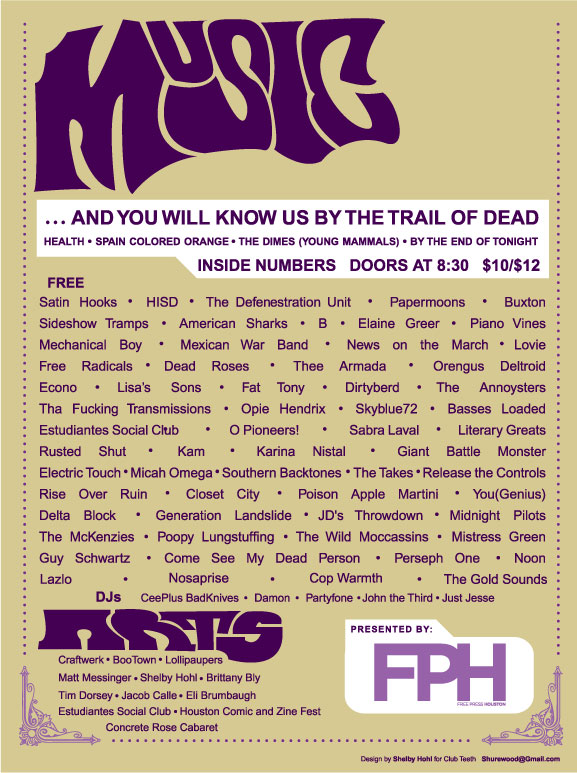
By April 12, 2008, the announcement promised fifty bands across six stages. The daytime event was free; the closing program inside Numbers carried a separate ten-dollar ticket. Even then, free admission and the cost of producing the day were beginning to negotiate with each other. We wanted as much of it as possible to remain open, and we were improvising ways to support that decision.
The surviving reviews bring that afternoon back into focus. The Houston Press caught News on the March at AvantGarden, Come See My Dead Person at Mango's, Mechanical Boy inside Numbers and Perseph One with AndAcc outside. Ramon Medina's FPH account follows a different route through Buxton, Wild Moccasins, Sideshow Tramps and other performances. The paper's announcement put ...And You Will Know Us by the Trail of Dead and HEALTH on the paid closing bill. There were several versions of the same day, depending on which room you entered and which set you managed to catch.
I remember the next day at Mango's particularly clearly. Jagi Katial approached me about collaborating on what would become Free Press Summer Fest. That conversation belongs here because it places the larger festival back inside the smaller one. Before the park, before the larger bills, there was a discussion at Mango's the day after a Block Party, between people who had seen what the event could do and could also see what it could no longer accommodate.
The first Summer Fest took place in 2009. The Block Party was still happening that year, so the history is less tidy than a handoff in which one event ends and its successor immediately begins. For a time, we were producing both. Summer Fest gave us a different site and a different financial model, while the Block Party continued to test the limits of the neighborhood arrangement from which it had grown.
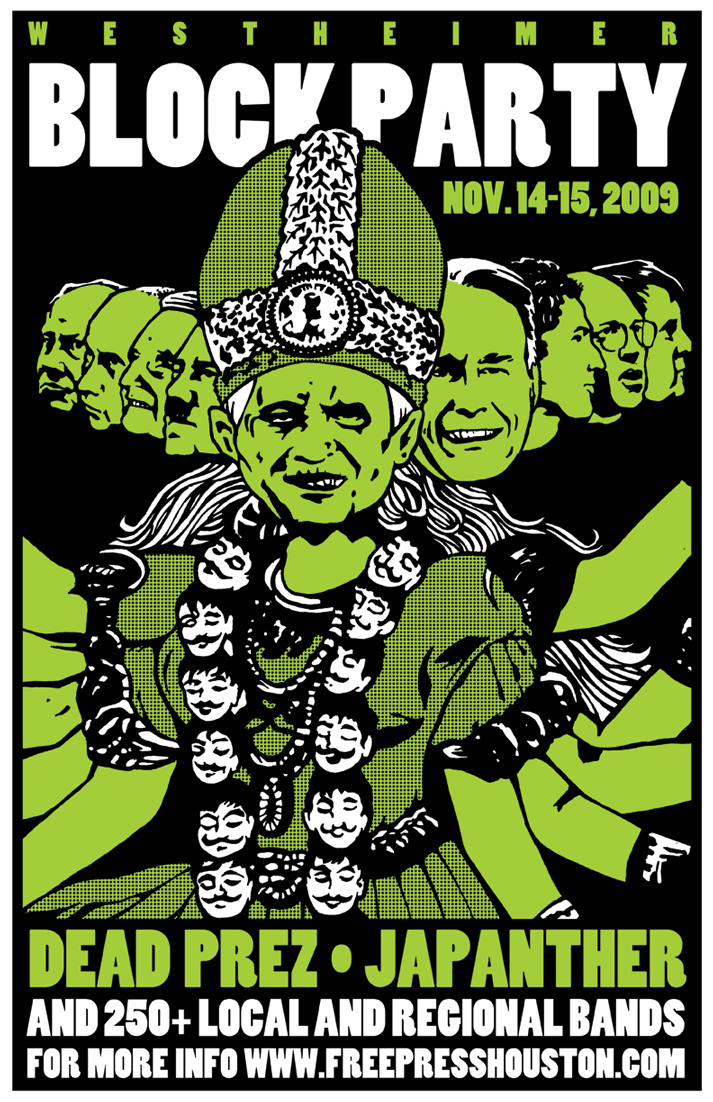
By then the bills had grown considerably. The March 2009 announcement included St. Vincent, Valient Thorr, Devin the Dude and HEALTH; the November edition advertised Dead Prez and Japanther in a separately ticketed evening show at Numbers. The local bands remained central, but we were learning how to put them in conversation with touring acts people knew from outside Houston. That made the project more ambitious and made its practical limits harder to ignore.
The cost of keeping it free
The November 2009 reporting makes the problem clear. We could attract more people than the arrangement could safely accommodate. We could keep finding ways to pay for the next edition, but that was becoming a substitute for a sustainable operating model. Free admission did not make stages, sanitation, security or the work of the staff free. It simply moved the cost somewhere else, and too much of it kept coming back to the same small group of people.
The street was the other part of the equation. The city would not close Westheimer for us. As the Houston Press reported in “The Lost Weekend?”, a smaller Taft closure was possible in 2009, but it did not turn the main road into a controlled festival site. An event that invited people to move among venues on both sides of Westheimer still had to contend with Westheimer functioning as a road. Growth made that contradiction more difficult to manage, not less.
In the statement reported at the time, I said, “I can no longer personally foot the bill.” That was a financial limit, but it was also an acknowledgment that the staff could not keep stretching indefinitely to contain a growing event inside the same limited space. I wanted the city behind it and the street closed so the event could operate safely. We had reached a point where another successful turnout could make the underlying situation worse.
The Block Party had become untenable in the form we were producing it. That remains an unfortunate measure of its success: people wanted it, musicians wanted to play it and the neighborhood could fill with it, but the willingness to make something happen could not keep replacing the conditions needed to sustain it. The last held edition, November 2009, belongs to that story as much as the first schedule does.
What stayed with us
When I look at the Block Party collection, I see the early education behind Free Press Summer Fest and, later, Day for Night. I also see a time before we knew how large the responsibilities could become. We were a young paper trying to do something useful for the music and people around us, and a great many people allowed us to learn at their expense: their time, their patience, their equipment and their willingness to show up.
That is the part I would like the archive to retain alongside the posters. The optimism was real. So was the work, and so were the limits. We began by trying to recover a piece of something Houston had lost, then discovered how much producing it would ask of us. I remember the stages and the vendors, the venues and the bands, and the trips back to the hospital. Andrea, quite reasonably, may remember that weekend in a different order.
Editorial and source note
This is Omar Afra's first-person account, supplied and developed for the archive in October 2026. The account of Khalil's birth, the hospital trips and the conversation with Jagi Katial at Mango's are Afra's recollections. The first edition's date, printed venues and bill are documented in Free Press Houston Issue 52, October 2005; later lineups, the 2008 announcement and contemporary reporting are linked above. Advertised bills are distinguished from independently confirmed performances. Photographs, artwork, maps and posters retain their existing archive credits. The archive's normal production disclosure should remain visible.