
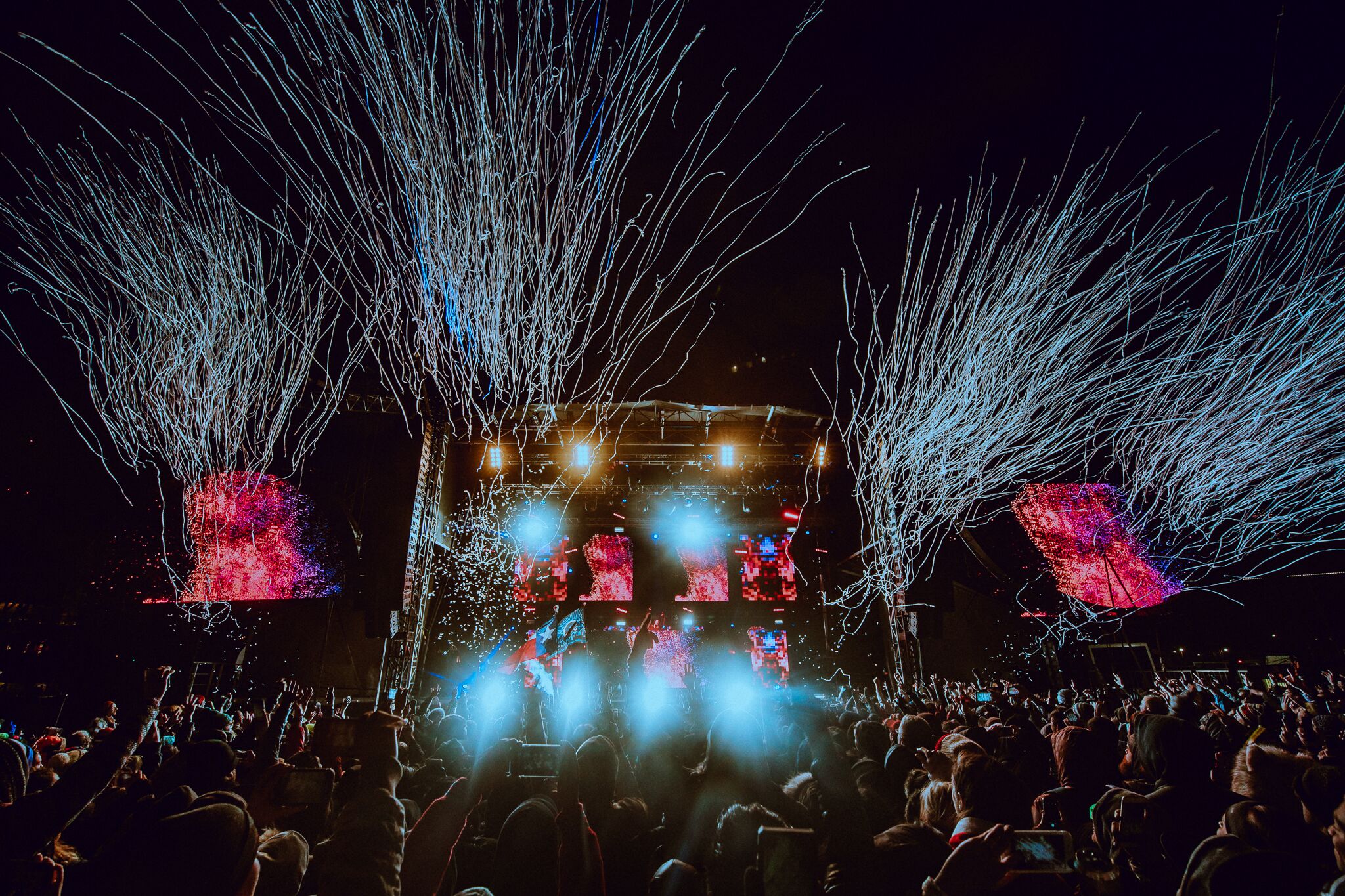
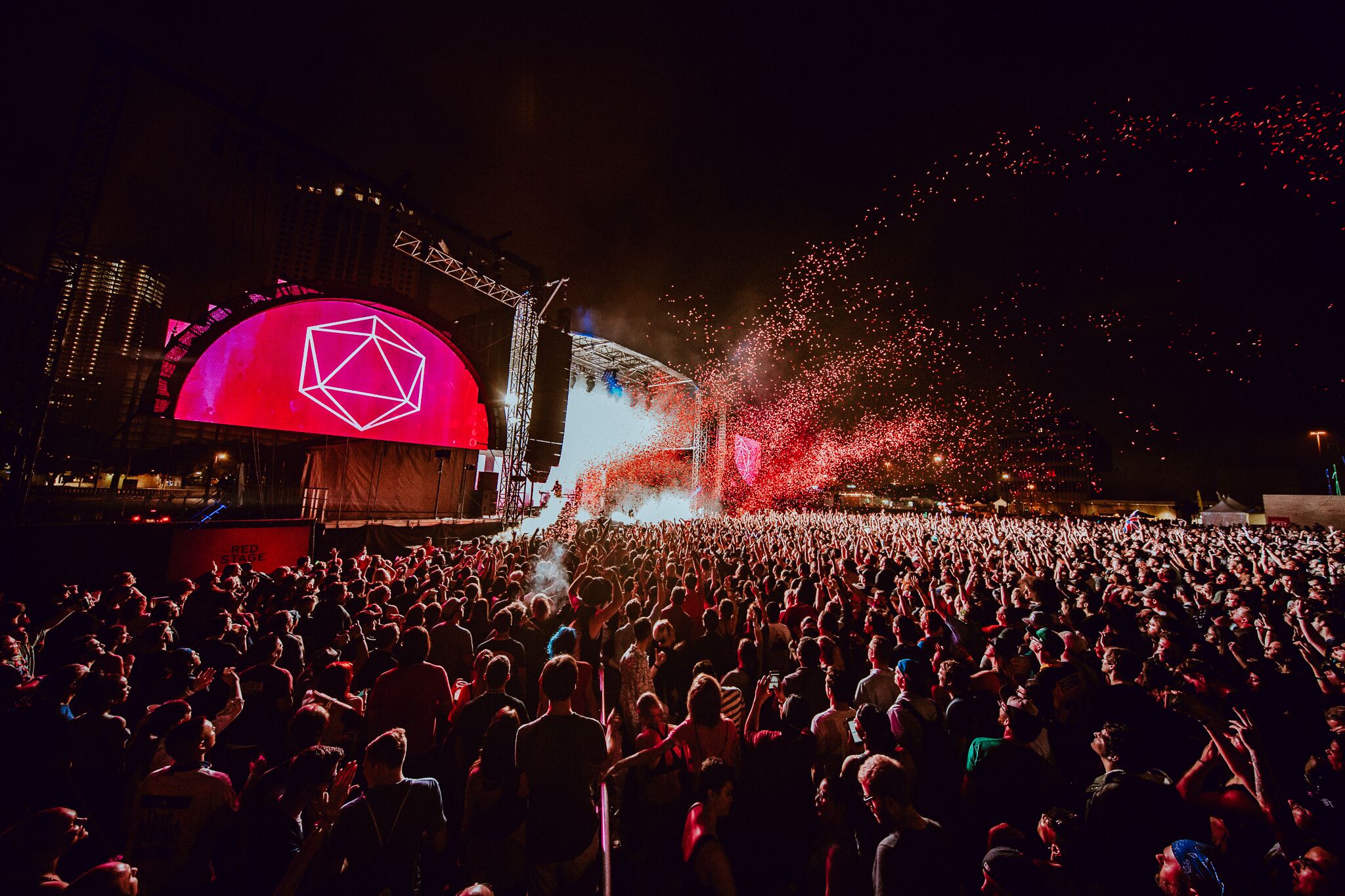
Origins
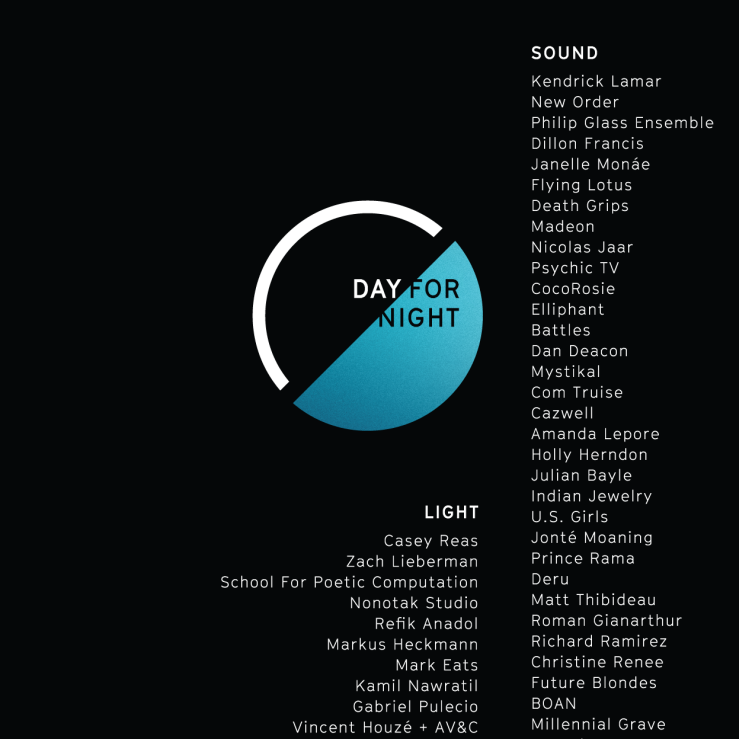
The day the money from my share of Free Press Summer Fest hit my account, I sent essentially all of it back out again to secure Kendrick Lamar and New Order for the first Day for Night. I was, technically speaking, a millionaire for less than twenty-four hours. This is probably not the method they teach at Wharton. That part makes a better story than what actually preceded it, which was a year or so of Kiffer Keegan and me talking ourselves into increasingly difficult ideas while we were already stretched thin making Free Press Summer Fest. The origin of Day for Night wasn't that we sat down one afternoon and decided Houston needed a digital-art festival. It came out of work we were already doing around FPSF, particularly in 2014, when Kiffer was developing the festival's visual identity and screen content.
Kiffer and I had known each other since we were kids. By then he had become a very serious branding and motion designer in New York, doing work through Work-Order for people with considerably more money and restraint than us. At FPSF he began pushing the on-screen language much further than what I was seeing at most American festivals at the time. The standard festival video package was often brutally utilitarian: camera feed, logo, maybe an artist name, perhaps an “UP NEXT” graphic sitting there like the departure board at a Greyhound station. Coachella and ACL were enormous, professionally produced operations, but the visual language of festival screens still often felt subordinate to the concert happening in front of them. Kiffer hated that deadness, and so did I.
We started treating screens as part of the environment rather than giant televisions. Graphics moved. Identities transformed. Material was rendered and revised almost in real time. We were creating content on site shortly before it appeared because once you start thinking of a festival as a living visual system, naturally the next reasonable decision is to give a bunch of exhausted people more things to finish at 3 a.m. But something more important was happening in those conversations. Kiffer kept showing me work that, at least in Houston then, you simply did not encounter very often outside certain museum and art-world circles: Ryoji Ikeda, Jenny Holzer, computational work, projection, light used as material, information turned into space. He wasn't just thinking about graphics anymore. He was thinking about what happened when messaging, architecture, motion, sound and an audience became parts of the same system, and that was the seed.
The problem with trying to do this at Summer Fest was Summer Fest itself. Eleanor Tinsley Park is beautiful, but it is a giant outdoor park in Houston in June. The sun goes down at approximately four minutes before everybody has to leave. There are no controlled rooms. There is little darkness. We had ideas that depended upon light, projection, enclosure and perceptual control, and a sun-blasted field is not especially cooperative with any of those things. I told the Houston Press at the time that people would be surprised how much available light dictated what could be programmed at FPSF, and Day for Night became, in part, the place where all the ideas that could not survive the conditions of Summer Fest were allowed to mutate. Houston Press, on the first edition.
By 2015, Free Press Summer Fest was also changing. What had started as a fairly improbable local project had become a large corporate festival, and control was moving away from the people who had built it. Live Nation was the dominant force in the American concert business, and as I understood the situation then, the alternative to working something out was potentially competing with another large summer festival at Eleanor Tinsley. I eventually sold my remaining interest. It was not an especially sentimental financial decision; I took the money and decided to build the other thing.
This is where the chronology becomes slightly insane, because while Kiffer and I were developing Day for Night, Free Press Houston and much of the same staff were still producing and marketing FPSF 2015. We were not sitting around a walnut conference table drawing diagrams of the future. We were finishing one enormous festival while inventing another. “Exhausted” does not adequately describe the condition. There were weeks when the distinction between ambition and neurological damage was not especially clear.
Still, we spent most of that year refining the proposition. We wanted someone entering Day for Night to feel that the normal rules of the city had been suspended for a few hours. The audience was not merely going to walk from stage to stage. They were entering an environment. At the time we used the word immersive fairly earnestly, and we should probably apologize. “Immersive” has since been murdered by marketing departments. Anything involving a projector and a beanbag is now immersive. A restaurant with purple LEDs is immersive. You can probably buy an immersive sandwich. But in 2015 the word still conveyed something useful to us: the environment would not be decoration around the programming. The environment was programming. A press release from that first year quoted Kiffer saying, “The entire campus will be an active experience with visual and experiential art installations.” That was not promotional frosting; it was the production brief. The 2015 lineup announcement.




Alex Czetwertynski and the Festival as Environment
During one of my trips to New York to work with Kiffer and the Work-Order team, Kiffer introduced me to Alex Czetwertynski. This was one of those introductions where you slowly realize the person sitting across from you understands the thing you are trying to do better than you do. Alex brought two things that Day for Night badly needed. One was an international curatorial perspective. The other was the brain of a technical director. Those abilities do not always occupy the same human being. Someone might understand contemporary art brilliantly and have no idea how to install twenty tons of electrically dependent work in an old industrial building full of drunk people. Or they know how to hang anything from anything but believe artistic discourse begins and ends with whether the LEDs look cool. Alex could move between both worlds.
His first-year explanation of the artists still describes the program better than most of the marketing language we produced around it. They came from different areas of digital practice — software, light, spatial work, interactive systems — but, he said, they all “use space, light and sound to create an experience.” The interview is held in the archive. That distinction became essential, because from the beginning we were determined that the visual program could not become a collection of shiny, twinkly shit placed around a music festival. There is nothing wrong with shiny, twinkly shit. People like shiny, twinkly shit. I like shiny, twinkly shit. But if we were claiming that art was equal to music, then we had to take the artists, the work, the technical conditions and the audience relationship seriously.
Alex pushed us deeper into that question. What does a work do to somebody physically? What happens to your perception of scale? Where does the audience stand? How does sound from an installation coexist with the bass pouring out of the stage next door? Does a piece reveal itself in thirty seconds or ten minutes? Is darkness a technical requirement or part of the work? What happens when 5,000 people try to see it? These sound like art questions. At festival scale they become engineering questions very quickly.
By 2016, that ambition had become much larger. Björk Digital came to Houston. Ryoji Ikeda, NONOTAK, Tundra and a host of international artists occupied the former Barbara Jordan Post Office. Houstonia photographed lines forming for installations and described the visual program as as much of a draw as the music. The Observer went considerably further and called Day for Night the future of music festivals, arguing that the exchange between art and music — not simply their coexistence — was what made the event unusual.
On the music side, Chris Wise deserves far more credit than the record usually gives him. An utterly brilliant talent buyer, Chris co-curated the musical lineup with me, and one of his real gifts was the middle of the card. He knew precisely which artists were making interesting, innovative musical moves before they had necessarily become obvious marquee names, and he understood how those bookings could give the festival depth rather than merely decorate the space between headliners. That judgment was crucial to Day for Night's musical identity. Chris later went on to Madison Square Garden Entertainment, where he is now Director of Booking.
What looked elegant to the audience was an unbelievable pain in the ass to produce. A normal large music festival is already an absurd machine. Talent, stages, generators, barricade, credentialing, police, fire, food, alcohol, sanitation, transportation, ticketing, medical, hospitality, hotels, runners, marketing, sponsors, weather, neighbors, permits and several thousand people who all need something immediately. Day for Night added what was effectively a temporary contemporary-art museum on top of that, and then we added a large-scale technology build on top of the temporary museum. It was like producing three festivals simultaneously and forcing them to share one nervous system.
The staff workload was incomprehensible. Marini van Smirren was running a general-management operation that had to reconcile all of this. Kiffer and Work-Order were treating branding, motion, signage and physical experience as a single visual language. Alex was curating works whose technical requirements could resemble small architectural projects. Chris Wise and the talent team were building a music festival whose lineup by itself would have been enough work for any sane organization. Mark Armes and the video people were documenting an event whose entire identity depended upon moving imagery. And every department still had the mundane realities of wristbands, radios, trucks, credentials, hotel rooms and somebody needing a golf cart that had disappeared twenty minutes ago. The fantasy was seamlessness; the reality was forklifts.
Art does not go under the band names
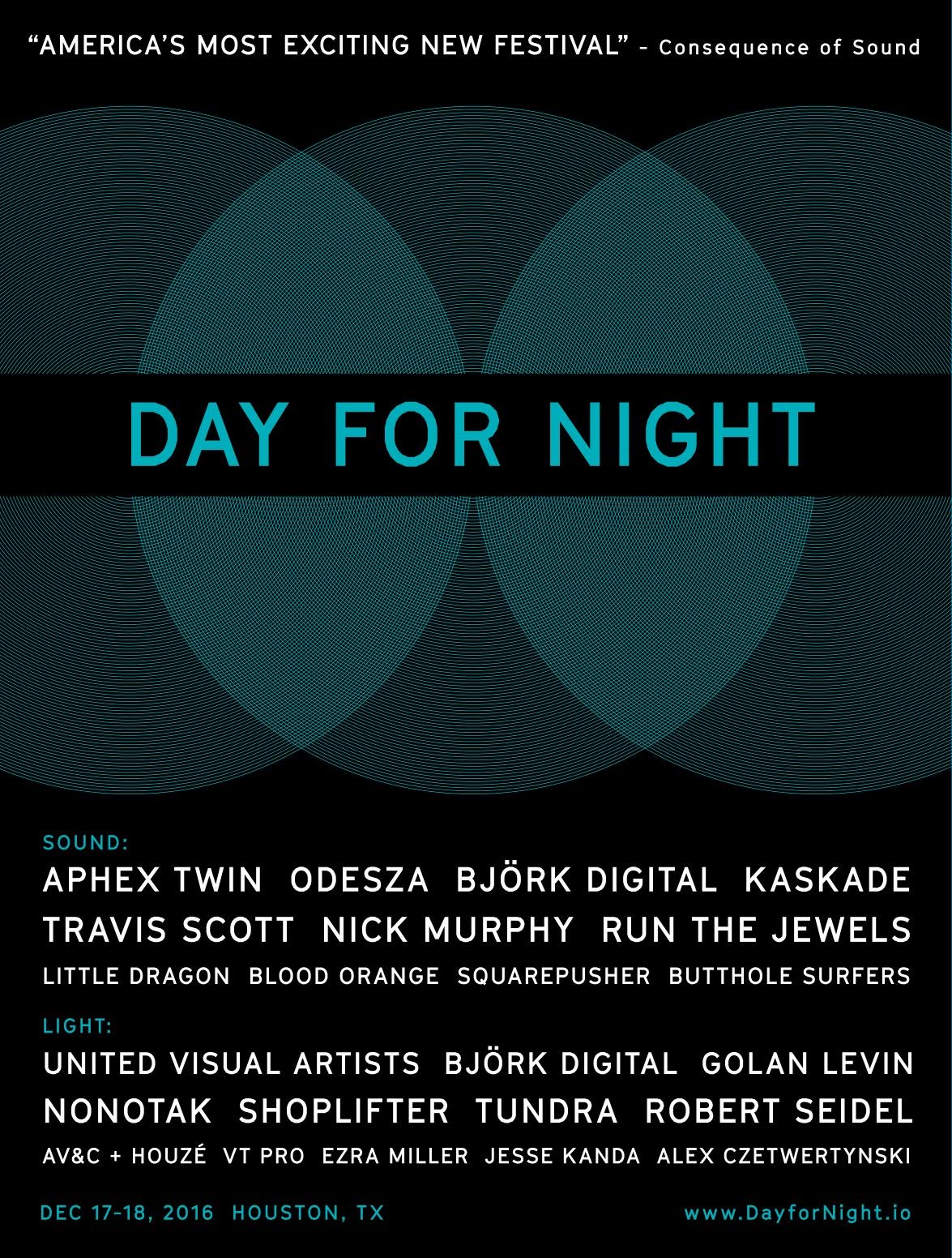
One of the most revealing arguments we had every year concerned the lineup poster. Agents understand hierarchy extremely well when the hierarchy benefits their client. Font size on a festival poster is apparently one of the foundational measurements of Western civilization. Put an artist six pixels too low and somewhere an attorney wakes up. Kiffer, Alex and I kept insisting that the visual artists had to appear on the same public face of the festival as the musicians. Not in a little “also featuring art by” box at the bottom. Not on a separate arts announcement nobody outside the art world would ever see. The entire premise depended upon saying that Ryoji Ikeda belonged in the same conceptual hierarchy as Nine Inch Nails; that a visual artist was not an amenity provided between Thom Yorke sets.
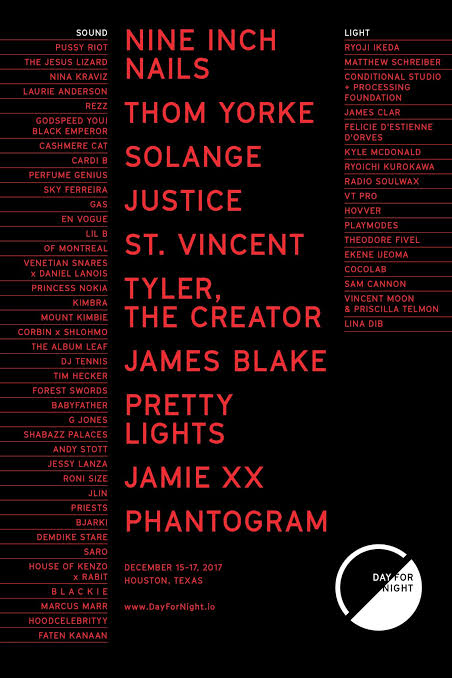
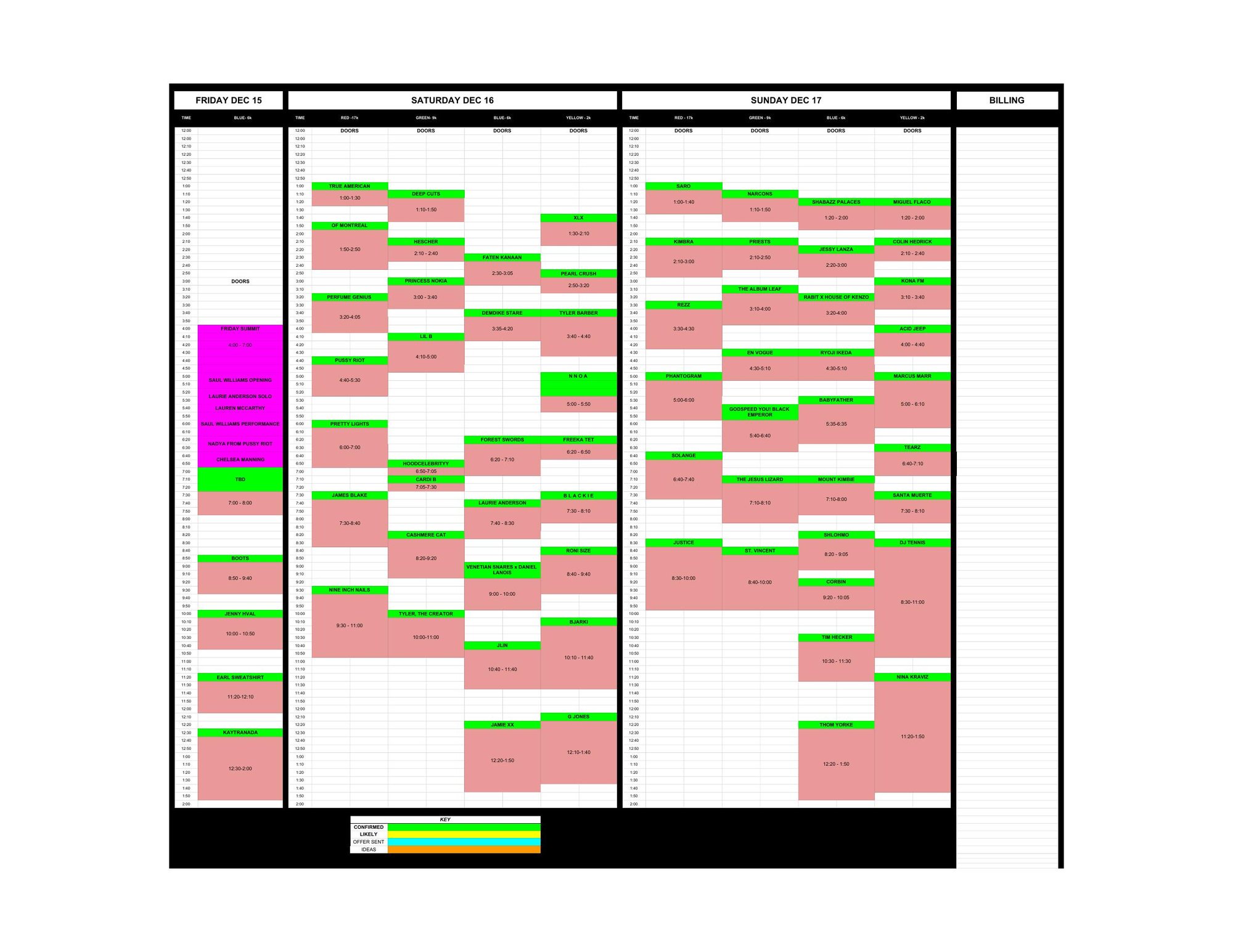
The 2017 materials ultimately made the argument graphically. The program used the headings SOUND and LIGHT, with both programs inhabiting the same identity system. Nine Inch Nails, Thom Yorke, Solange, Justice and St. Vincent occupied one side of the proposition; Ryoji Ikeda, Matthew Schreiber, James Clar, Kyle McDonald and the other visual artists occupied the other. It sounds obvious now. It did not feel obvious then, and there was constant pressure — some of it perfectly understandable — to explain who these people were and why their names were receiving real estate that could have gone to musical talent. My response was essentially that this discomfort was the point. If we only treated visual art as equal after everybody already recognized all of the visual artists, then we weren't actually treating it as equal.
Alex later articulated the deeper philosophy better than I could. He told Nylon that he believed meaningful artwork could exist “not made for an art crowd,” and that mattered enormously to us. Day for Night was never supposed to require permission from the museum world. Nor was it supposed to dumb art down for a festival audience. We wanted somebody who had come to see Travis Scott or Aphex Twin to accidentally spend fifteen minutes inside a work they could not immediately explain. Conversely, we wanted the art audience to encounter music as more than a soundtrack for a gallery opening. That exchange was the whole game.
None of this was really new
One thing I became increasingly convinced of while building Day for Night was that the supposed marriage of visual art and music was not actually a futuristic idea. It was a reintroduction. Music has always been visual and spatial. Religious ritual understood this before anybody invented the concert business. Opera certainly understood it. Psychedelic concerts understood it. The light shows, poster art, happenings, costumes and environmental experimentation around 1960s music were not supplemental merchandise. They were part of the experience. Somewhere along the development of the large American festival business, a lot of that got standardized into something much more efficient: bands in a field, beer, sponsor activations, a Ferris wheel if somebody was feeling dangerous. That model made economic sense. It was also starting to become visually and experientially interchangeable.
By 2017, I told Pitchfork that the integration of non-musical elements felt less like innovation than restoration. New media and computational art were colliding naturally with music because the same technological tools — large LED surfaces, projection, lighting control, real-time processing — were increasingly available to both worlds. The difference was what the artist made those tools mean. Today this barely requires explanation. A local club show can have production technology that would have been extraordinary fifteen years ago. Touring artists arrive with entire visual worlds. Generative content, synchronized lighting and giant video surfaces are normal parts of the grammar of live performance. In 2015 that convergence was already coming, of course. Day for Night did not invent it. That would be an idiotic claim. What I think we did unusually well was recognize it early enough to build the institution around the collision, rather than add the collision later as decoration.
Kiffer once described Day for Night as an “anti music festival music festival.” That phrase is funny, but it also gets pretty close to what we were attempting. Work-Order's identity was based on transformation, motion, light against darkness and sound against silence, and the branding did not sit on top of the event — it behaved like the event. AIGA Eye on Design, on branding a festival. The archive holds that identity work in the collection's Work-Order record.
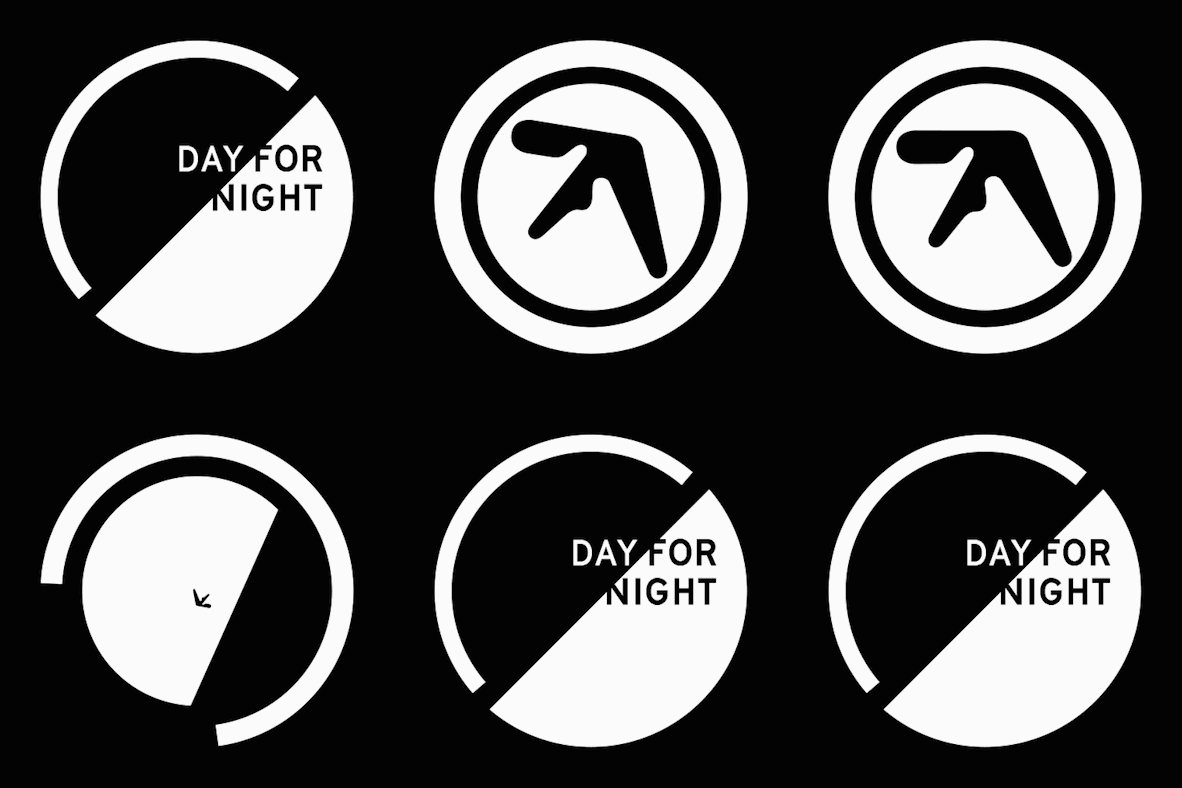
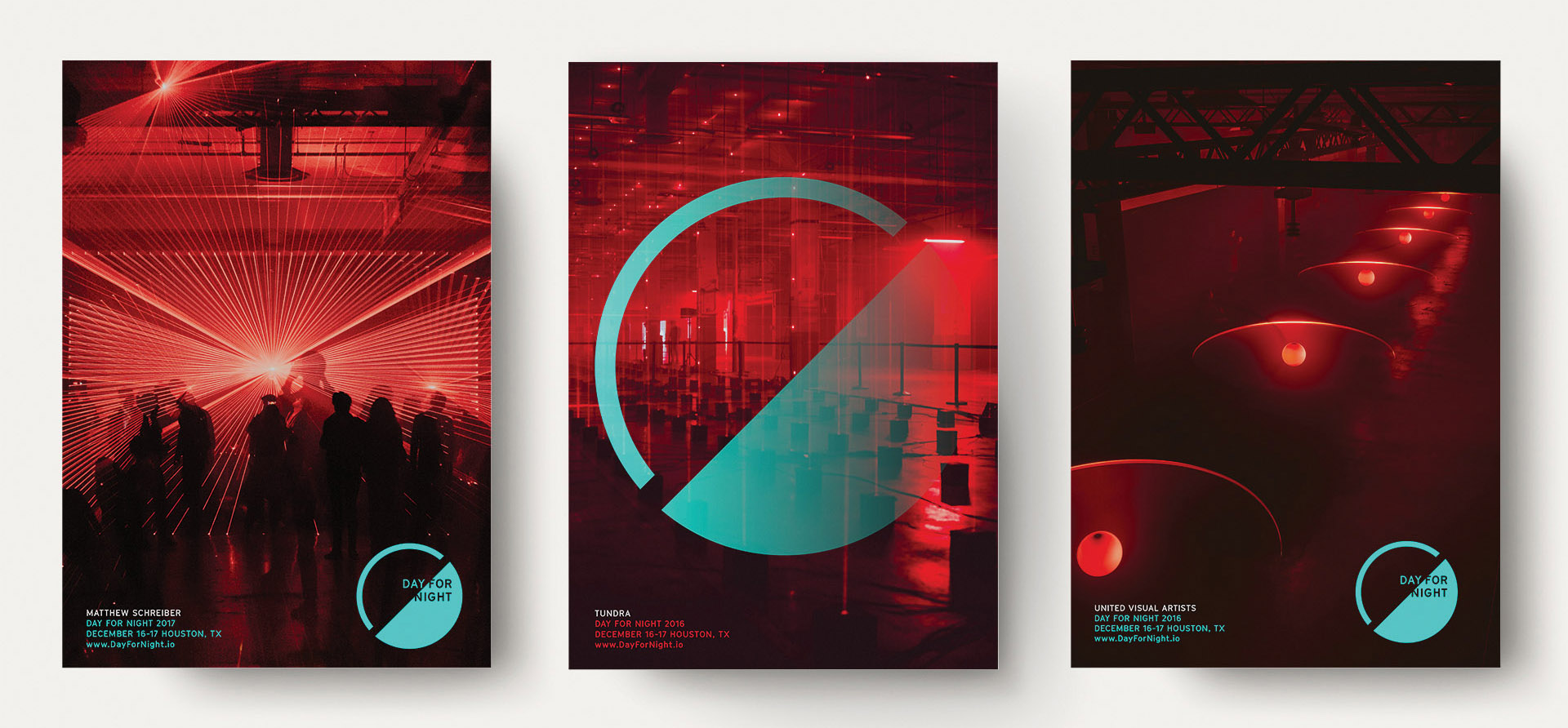 Branding at scale: the red, cyan, white and black system repeated across a field of posters, one grammar carrying announcements, signage and screens alike.
Houston was part of the medium
There is another reason Day for Night could happen in Houston that is harder to explain to people who only know the city from airports and oil-company annual reports. Houston has always been weirdly permissive. The city is physically enormous, architecturally inconsistent, institutionally ambitious and aesthetically unembarrassed. It has world-class museums sitting a few miles from warehouses, strip centers, refineries, Vietnamese restaurants, megachurches and empty industrial buildings. Houston frequently looks unfinished because, in many ways, it is always being rebuilt, and for Day for Night that was useful.
The former Barbara Jordan Post Office was not a neutral container. It was a gigantic obsolete machine. Concrete, loading bays, low ceilings, enormous rooms, mechanical residue, darkness, ramps, ducts and a skyline outside the windows. Moving there in 2016 changed the festival because the building became a collaborator. The Houston Press understood this early, describing the site itself and the audience as components of the installation. Alex understood it immediately. He saw the possibility of using a structure like that not simply to house work but to change how the work behaved. And Houston's audience proved much more adventurous than people outside Houston — and occasionally people inside Houston — assumed it would be.
By the third year, publications that ordinarily had little reason to discuss Houston as a center of experimental culture were coming here specifically because of the festival. Pitchfork wrote about Day for Night in the context of the broader transformation of festival culture. Mixmag described it as an “immersive haven for innovative talent.” Consequence of Sound named the 2017 edition its Festival of the Year. I am naturally suspicious of declaring one's own historical importance. Anybody who has spent time around the art world has encountered the guy explaining why the group show he organized above a coffee shop fundamentally altered Western consciousness, so I will leave the grander claims to other people. What I can say is that Houston looks different to me now.
What remained
The most gratifying legacy of Day for Night is not that other festivals began using more projection or booking digital artists. That was happening everywhere and would have continued happening without us. The more interesting legacy is that the proposition no longer sounds strange. A visual artist can headline an experience. A music audience will spend meaningful time with difficult digital work. An old industrial building can function simultaneously as club, museum, stage and social space. And Houston can sustain an audience for all of it.
The clearest local descendant is almost absurdly literal. Art Club opened at POST Houston — the redeveloped Barbara Jordan Post Office where Day for Night's second and third editions took place. The Houston Chronicle described it as reviving Day for Night's fusion of music, art and technology and noted that nothing in Houston since had matched the festival's scale and experimentation; Houstonia described the project as explicitly picking up where multimedia festivals like Day for Night left off. The venue's own programme page now describes a black-box museum of new-media art that shifts into a club environment, with artists working in light, sound, computation and interactive media. In other words, a set of ideas that in 2015 required paragraphs of explanation can now support a permanent institution in downtown Houston.
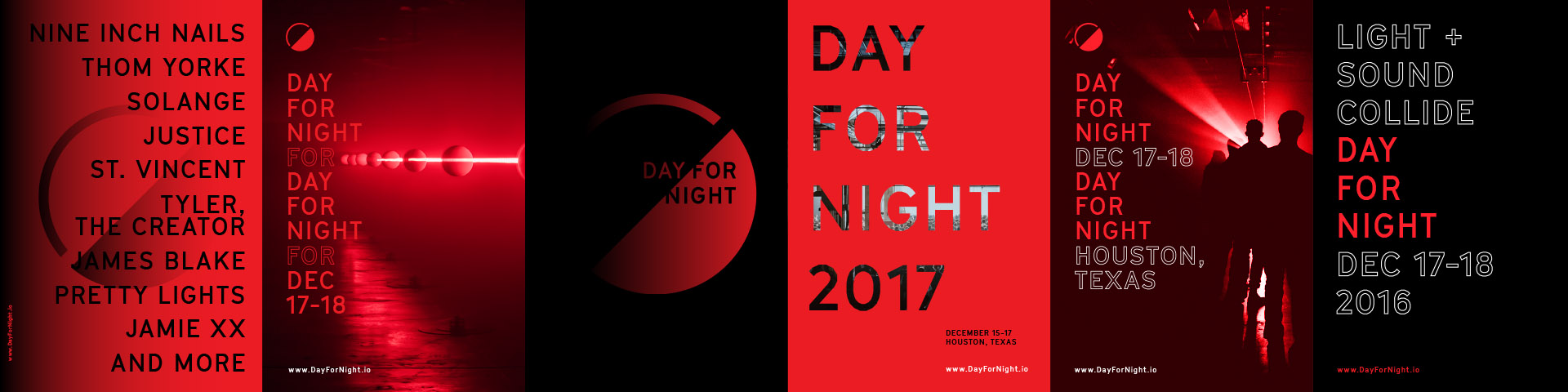 Proliferating the mark: red wildposting across an exterior wall, the identity leaving the venue and taking the street.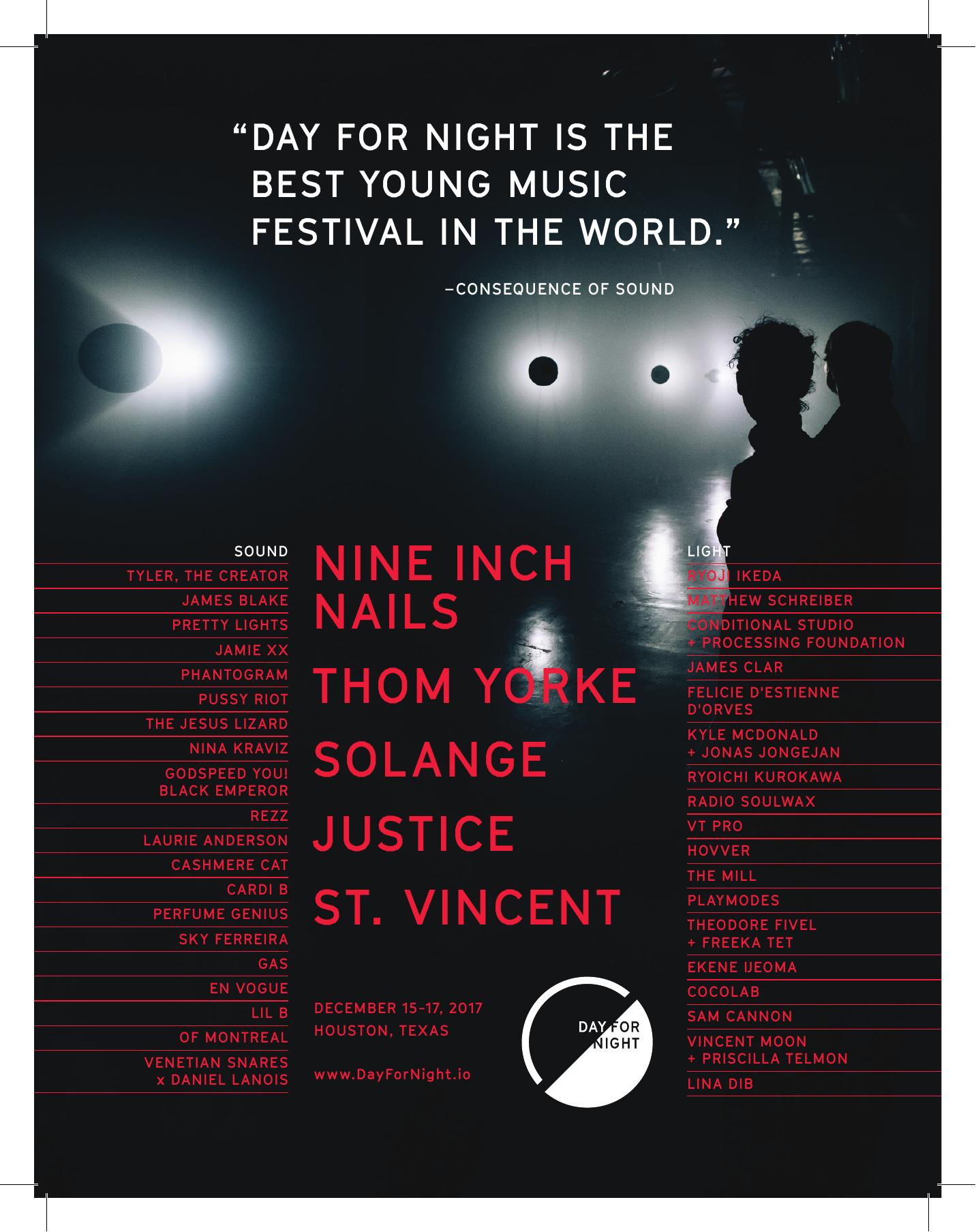
I am not claiming Day for Night created that future. Culture does not work that neatly. Ryoji Ikeda was Ryoji Ikeda before we ever managed to pronounce his name correctly. Jenny Holzer did not require three Houston guys to discover text and light. Kiffer brought an entire design history into the project. Alex brought a curatorial and technical vocabulary far beyond mine. Artists around the world were already collapsing the boundaries between computation, image, architecture and sound. What Day for Night did was make that collision public, popular and enormous in Houston.
For three Decembers we got to build a temporary city where New Order and Kendrick Lamar, Björk and Aphex Twin, Nine Inch Nails and Thom Yorke could coexist with artists making work out of lasers, algorithms, projection, darkness, architecture and sound — and where we insisted, sometimes obnoxiously, that all of it belonged on the same poster. I look back now and mostly wonder how the hell the staff survived it. We were not producing one festival. We were producing a major concert event, an international contemporary-art exhibition and an experimental technology environment simultaneously, with many of the same people responsible for all three. It was financially reckless, physically exhausting and operationally unreasonable, which is probably why it worked. The reasonable version would have been bands in a field.