
Houston Music Archive
Free Press Houston, the festivals it produced, the rooms it covered, and the artists and objects left in the record.
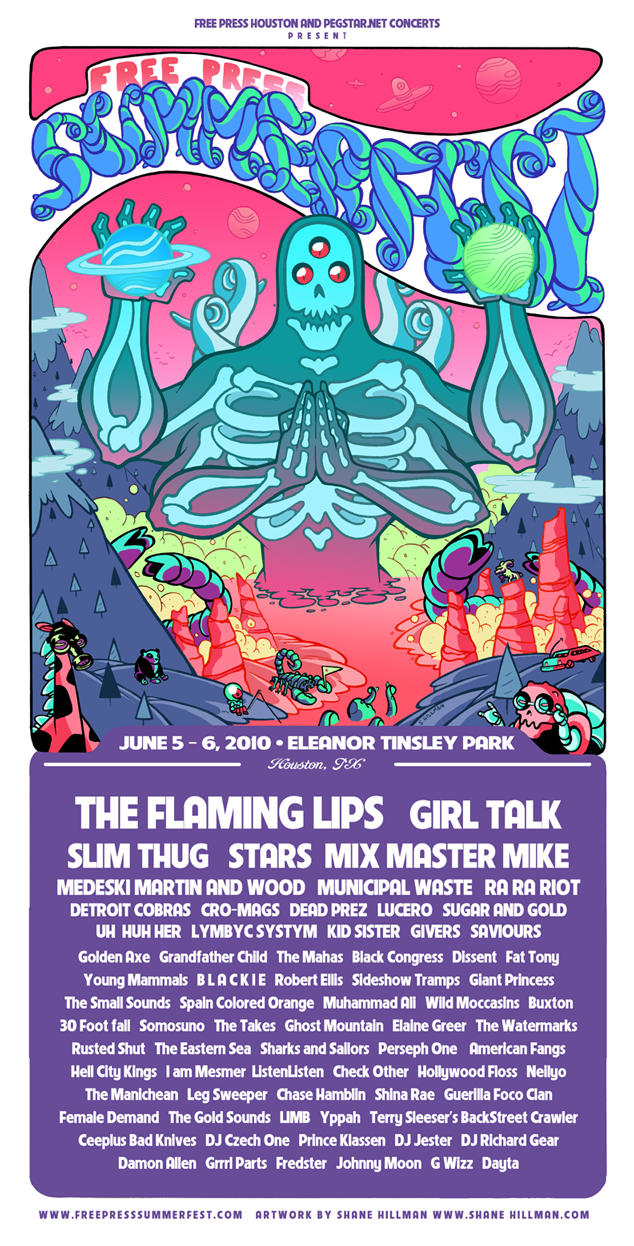
Free Press Houston was an independent Houston newspaper published from 2003 to 2018. Its music pages sit alongside print issues, festival guides, photography, advertisements and artwork. This finding aid does not turn those different kinds of evidence into a single continuous history. It points to the surviving records and to the people and places named in them. Artist interviews provide another entry point: Robert Ellis on recording and local influences and Female Demand on the band’s name and plans preserve the musicians’ own accounts rather than a later summary of a scene. Start with the paper’s entity record for the publication, or browse digitised issues to see music coverage in its printed context. Weekly guides such as Love Yourself, Loose Change and Serial Killa preserve the paper’s contemporary concert listings alongside its festival records.
The earlier club record includes the April 2008 Westheimer Block Party preview, the first Recession Thursday bill at Numbers, Papermoons and Bright Men of Learning at the Mink, and Sharks and Sailors, Ume and the Jonx at Walter’s. The SXSW day-two and day-four reports follow Houston acts alongside touring artists in Austin.
The Westheimer Block Party brought the newspaper into festival production around Westheimer and Taft. Its held guides, lineups, posters and photographs trace the different editions without flattening them into one lineup. Numbers, AvantGarden/Helios, Mango’s and La Strada appear in this street-level record. Dated edition pages distinguish what was planned from what the archive can establish happened; printed pages and objects preserve the form in which audiences encountered the event.
Free Press Summer Fest, begun in 2009 with Pegstar, moved the production to a larger scale. The collection follows nine editions through lineups, posters, maps, photographs, video and reporting. Its early years are tied to Eleanor Tinsley Park; later records document weather-related moves and changing sites. An edition page, rather than a later summary, is the place to check which artists, dates and visual materials are evidenced for any given year.
The Day for Night archive follows a different combination of music and new media art in 2015–2017. The 2016 and 2017 records connect the festival to the Barbara Jordan Post Office at 401 Franklin. Posters, schedules, site plans, art records and crew documentation show how sound, light, technology and the building were assembled into an event; later coverage is kept distinct from contemporary festival material.
Festivals were only part of the city's music infrastructure. The lost venues directory collects closed rooms named by the paper, including Walter’s, Fitzgerald’s, Engine Room, Jet Lounge and The Proletariat. Each entry separates sourced addresses and spans from open questions. The Fitzgerald’s collection goes further into the Pegstar / Free Press Houston operating years, while the individual place pages keep each room’s longer history visible.
Two performer indexes serve different questions. The Performer Registry normalises names found on FPH-produced bills without claiming every appearance was local. The Houston Local Band Registry is a documented sample of Houston-area acts, with provenance and links into the held record. A festival appearance alone does not establish where an artist came from. Follow each act’s evidence and the event record rather than treating either register as an exhaustive account of Houston music.
The object catalogue preserves posters, covers, maps and other surviving artifacts at their own addresses, with credit and source information where held. A poster can lead back to its edition; an edition can lead to its poster. Writers, artists and contributors provide another route through the corpus: bylines, artwork and staff credits connect creative work to the newspaper and its events. These relationships are evidence trails, not inferred credits for everything a festival produced.
Omar Afra’s contributor record gathers the founder and publisher’s recovered writing and documented festival relationships. Separate finding aids for the publication, Summer Fest and Day for Night keep his roles attached to their supporting records. This page is a map between those collections, places, people and material objects. Where the archive cannot identify a creator or date a file, the uncertainty stays with the record.