
The Cargo Space
From the Houston Ballet to the Houston Grand Opera to The Museum of Fine Arts, Houston prides itself on the arts. However, not every city in the world has access to renowned performing and visual arts companies— and that is why the “Cargo Space” came into being.
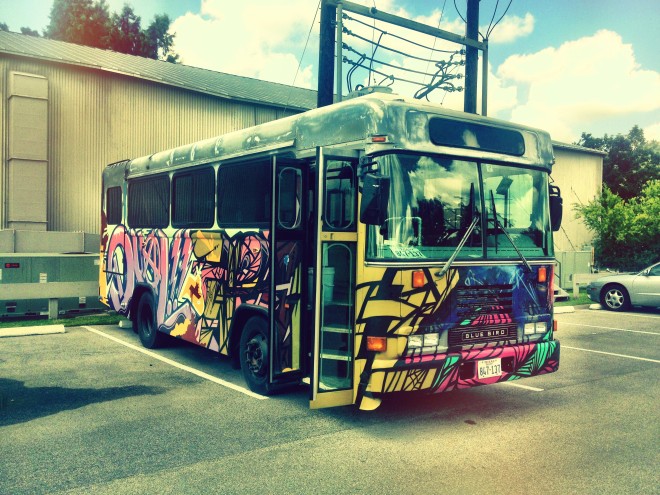
The Cargo Space is art itself on wheels. The new creative project by Christopher Sperandio and Simon Grennan is a way for people across the Southwest and across the world to experience all forms of art and for artists to engage in creative exchanges.
According to the project leads, the Cargo Space is a project that was built out of need. Sperandio and Grennan acquired a grant from the Rice University’s Humanities Research Center and a Rice transit bus, which they are transforming into a “mobile arts platform.” They describe the bus as a “part rockstar-stye tour bus, part utility vehicle and ultimately a blank platform that sleeps six.”
The vehicle will transport artists and cultural workers in all fields and from across the world to participate in events and other activities designed to promote cultural exchange and expansion.
Assistant Professor of Art in the Department of Visual and Dramatic Arts at Rice University Christopher Sperandio explains the inspiration behind the Cargo Space and his goals for the project:
How did you come up with the idea for the Cargo Space?
It’s been on my mind for more than a dozen years. I’ve done a lot of
research on alternative living practices: folks who build small,
low-budget homes, house boats, and, of course, those who convert
school buses into mobile residences. This research was always that,
just research. Then it began to gel with some ideas that I’d been
having about Houston, and how we desperately need more exchange with
artists and thinkers in other places. The two areas of concern just
dovetailed together. An inexpensive and nontraditional residence for
artists.
Which regions in the United States do you plan to visit?
I hope we can go everywhere the road can take us. I’d love to escape
the boundaries of the US. We could drive to the tip of South America
or up into Canada. We plan to start small, to get the feel of the
thing, and then to push out.
How will you determine which artists to take on tour?
It’s currently by invitation only. I’ve been thinking about different
mechanisms for how we might find artists and writers who would be good
for the project, but we’re right in the thick of installing the
plumbing and electrical systems, so it’s at the back of my mind. I’m
thinking about it, though.
Will artists be required to pay to use the vehicle for tours?
I want to pay artists to be on the bus, not the other way around, but
(and here’s the scandalous part of the interview) there’s more to life
than money! I have an idea that everyone should contribute something.
Right now everyone is volunteering to work on the bus, because it’s a
project that they believe in. I’d like to carry that practice forward.
If you believe in the idea, then you should demonstrably support it
and help improve the project somehow. Build us a killer web site,
improve the gas mileage, make T-shirts for everyone. This isn’t a
major issue, but it is something else that I’ve been thinking about.
Will each tour bring one type of artist at a time (poets, visual artists
or will an assortment of artists go on a tour?
An assortment, definitely. I also don’t want to constrict it to just
those who self-identify as artists. Sociologists? Maybe. Really anyone
who might be able to do something interesting with the experience.
Who do you expect the audience to be? Will the bus visit a certain
type of venue or gallery?
For the most part, there may be no audience. It’s an artwork whose
primary purpose is to engage other artists (practitioners, thinkers,
whatever). We may organize public events around the bus, but sometimes
we’ll just be going somewhere. Sometimes we’ll do something public,
and sometimes the whole thing will be private.
Do you plan to collaborate with other companies to put on events?
I think Cargo Space is the perfect art work for an oil and gas company
to sponsor outright. This is an oil and gas town, and this is an oil
and gas project, literally.
How long will tours last?
Anywhere from days to weeks. It really just depends on who is
involved, where they need or want to go, and what we do when we get
there. I’m open.
How many tour buses do you ultimately plan to use for the project?
When we’re not able to go on the road, I hope to use the parked bus as
a residence for visitors. Any week that the space is empty is a wasted
opportunity. When we can, we’ll take trips. When we can’t, the space
will be a static living space.
When do you expect tours to begin? Where will the first ones go?
As soon as we finish the plumbing and electrical, we’ll get the
vehicle reclassified as an RV. We’ll take a number of shake-down
cruises to make sure everything is working right. Our first official
trip is still top secret. We’ve got our fingers crossed, but we just
can’t say anything until it’s a done deal.
What does the bus look like? How has it been remodeled in terms of
decoration and functionality?
The bus is a 25′ long Blue Bird CS FE. CS stands for commercial
series, and FE stands for front engine. The living space consists of a
dinette that seats four, a bench seat for guests, a galley
kitchenette, a lavatory, a bunk room, and a modestly-sized private
cabin in the back. Maximum capacity is six, but I think the most we’ll
travel with, typically, is three or four. Six people sharing a 200
square foot living space seems a little much for anything but a long
weekend in the mountains, or at the beach. A future phase of the
project (funding permitting) is to add a walkable roof rack that can
support the weight of six people. We’re also thinking about installing
a 90″ wide high definition video screen in the back window, facing
outwards. We’ll be able to roll up on spots and do impromptu
screenings, play games and figure out ways for people to interact via
their smart phones.
Is there anything else people should know about the Cargo Space?
It’s not too late to get involved! If you think you have some
serviceable skill, or free time, raw enthusiasm and a sense of
commitment, email us. Innovation is a rare creature, and should be
supported whenever it appears, so give us money. Your contribution is
tax-deductible and you can do it online at thecargospace.com
To see more pictures and learn more about the Cargo Space check them out online!
Blog: http://thecargospace.com/post/ 52869343835/unistrutting-our- stuff
Facebook: https://www.facebook.com/ TheCargoSpace
by Guest Author